
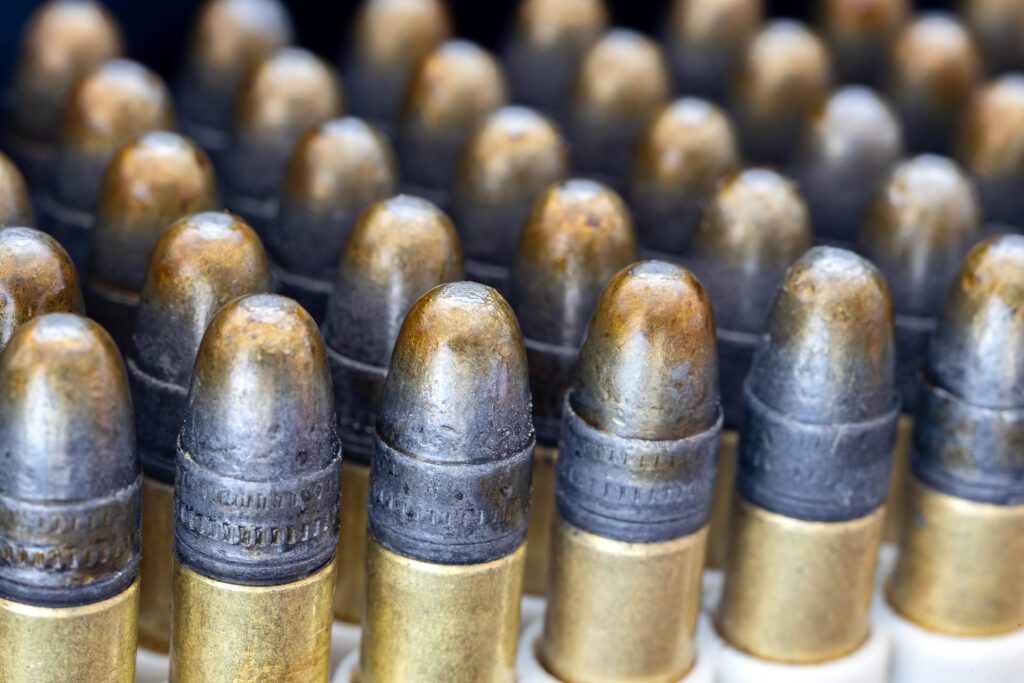
Your complete guide to the five essential rimfire calibers — .22 LR, .22 Magnum, .17 HMR, .17 WSM, and .22 Short. Compare ballistics, best uses, and top ammo picks so you can choose the right rimfire round for training, hunting, and everything in between.
Ammo Guide Series — Explore All 5 Guides:
Rimfire Calibers — You are here
Rifle Calibers — Coming Soon
If you’ve spent any time at a shooting range, you’ve heard the familiar pop-pop-pop of rimfire rifles and pistols echoing down the line. Rimfire ammunition accounts for billions of rounds sold every year in the United States, and for good reason.
These cartridges are affordable, low-recoil, and endlessly versatile — perfect for everything from teaching a new shooter the fundamentals to dropping prairie dogs at 200 yards. But not all rimfire calibers are created equal. The difference between a .22 LR and a .17 WSM is massive in terms of velocity, trajectory, terminal performance, and cost.
Whether you’re stocking up for a weekend of plinking, choosing the right round for pest control on your property, or chasing varmints across open fields, understanding what each rimfire caliber brings to the table will help you make smarter buying decisions and get better results downrange. In this guide, we’ll break down the five most important rimfire calibers available today.
What Makes Rimfire Different from Centerfire?
Before we dive into individual calibers, it helps to understand what makes rimfire ammunition fundamentally different from its centerfire counterparts. The name tells the story: in a rimfire cartridge, the firing pin strikes the rim of the cartridge base to ignite the primer compound, which is spun into the entire rim during manufacturing. In centerfire ammunition, the firing pin strikes a separate primer seated in the center of the cartridge base.
This design difference has several practical implications. Rimfire cartridges use thinner, softer brass cases because the firing pin needs to crush the rim to ignite the primer. That means rimfire cases generally can’t handle the high pressures that centerfire cases can, which limits rimfire calibers to lower velocities and lighter bullets. It also means rimfire cases aren’t reloadable — once you fire them, they’re done.
Key takeaway: The simpler manufacturing process makes rimfire ammunition significantly cheaper than centerfire. You can buy a box of 50 rounds of .22 LR for less than the cost of a single box of 9mm in many cases. That affordability is what makes rimfire the foundation of American shooting sports.
.22 LR — The Undisputed King of Rimfire
The .22 Long Rifle is, without exaggeration, the most popular cartridge in the world. Introduced in 1887 by the J. Stevens Arms & Tool Company, the .22 LR has been the default training, plinking, and small game cartridge for well over a century. More firearms have been chambered in .22 LR than any other caliber, and more rounds of .22 LR are fired in the United States each year than any other cartridge — by a wide margin.
Ballistics and Performance
Standard .22 LR ammunition pushes a 36- to 40-grain bullet at velocities ranging from about 1,050 fps (subsonic loads) to 1,260 fps (high velocity) and up to 1,640 fps for hyper-velocity offerings like the CCI Stinger. Muzzle energy typically falls between 100 and 140 foot-pounds, depending on the load. That’s not a lot of power compared to centerfire cartridges, but it’s more than enough for small game at reasonable distances and perfectly adequate for target shooting and training.
Effective range for the .22 LR is generally considered to be around 75 to 100 yards for hunting applications, though skilled shooters regularly ring steel at 200 yards and beyond in competition settings. The relatively slow velocity and lightweight bullet make it susceptible to wind drift at longer ranges, which is actually part of what makes long-range .22 LR shooting such a rewarding challenge.
Best Use Cases
What to Look For
For general plinking and training, it’s hard to beat the value of bulk packs. The Blazer .22 LR 40-grain Lead Round Nose runs just $3.55 for a box of 50 — about seven cents per round — and cycles reliably through most semi-automatics. For small game hunting where you want a bit more terminal performance, the CCI Velocitor in 40-grain hollow point delivers a noticeable step up in velocity and expansion. And if you want the fastest .22 LR you can buy, the CCI Stinger at 1,640 fps is a time-tested favorite that’s been devastating varmints for decades.
For suppressor owners, CCI’s Clean-22 line deserves special attention. The Clean-22 Hyper Velocity uses a polymer bullet coating that reduces copper and lead fouling by 60 to 80 percent — a real advantage when you’re cleaning a suppressor.
If you’re buying in bulk for a long range day, the Winchester .22 LR 36-grain Plated Hollow Point 222-round box is a solid option at $12.70, and for serious stockpiling, the Winchester USA White Box 1,000-round brick gives you the ultimate bulk value.
.22 WMR (.22 Magnum) — The Significant Power Upgrade
Introduced by Winchester in 1959, the .22 Winchester Magnum Rimfire (commonly called .22 Magnum or .22 WMR) was designed to give rimfire shooters a meaningful step up in power over the .22 LR. It succeeded. The .22 WMR generates roughly two to three times the muzzle energy of a standard .22 LR, extending effective range and dramatically improving terminal performance on small game and pests.
Ballistics and Performance
The .22 WMR fires a slightly larger-diameter bullet (.224″ vs .223″ for .22 LR) from a longer case with more powder capacity. With 30-grain bullets, velocities reach 2,200 fps from a rifle barrel, generating around 300 foot-pounds of muzzle energy. Heavier 40-grain loads clock in around 1,875 fps with similar energy figures. That’s a massive jump from the .22 LR’s 140 foot-pounds, and it translates directly into flatter trajectories, harder hits, and a usable effective range out to 125 to 150 yards for hunting.
The .22 WMR also has one interesting niche that the .22 LR doesn’t fill well: it’s a viable, if modest, option for personal protection in small-frame revolvers. While no rimfire caliber is ideal for self-defense, the .22 WMR’s extra velocity and energy make it a more serious proposition for shooters who can’t manage centerfire recoil.
Best Use Cases
What to Look For
For varmint and pest control work, the Hornady Varmint Express .22 WMR 30-grain V-Max is a top pick. The polymer-tipped V-Max bullet is designed for explosive expansion on small-bodied animals, and Hornady’s quality control is excellent. CCI also offers the VNT .22 WMR 30-grain Varmint Tip with similarly devastating terminal performance and flat trajectories.
For general hunting with heavier bullets, the CCI Maxi-Mag 40-grain JHP has been a rimfire hunting staple for years at a very competitive $14.20 per box — and Zeth Ammo currently has excellent stock depth on this one.
For personal protection, the Speer Gold Dot Short Barrel .22 WMR 40-grain is the gold standard. Speer specifically designed this load to expand reliably at the lower velocities produced by short-barreled revolvers, using the same bonded Gold Dot technology trusted by law enforcement in their centerfire duty ammunition.
.17 HMR — The Varmint Hunter’s Laser Beam
Introduced in 2002 by Hornady, the .17 Hornady Magnum Rimfire was a game-changer for rimfire varmint hunters. By necking down the .22 WMR case to accept a tiny .172-caliber bullet, Hornady created a cartridge that shoots flatter, drifts less in the wind, and hits harder at distance than anything else in the rimfire world (at the time of its introduction).
Ballistics and Performance
The .17 HMR pushes a 17-grain bullet at approximately 2,550 fps from a rifle barrel, generating around 245 foot-pounds of muzzle energy. While those energy numbers are actually slightly less than the .22 WMR, the .17 HMR’s real advantage is its trajectory. At 100 yards, a .17 HMR drops only about 1 inch when zeroed at 100 yards, compared to roughly 3 to 4 inches for the .22 WMR. At 150 yards, the advantage becomes even more pronounced.
The tiny, fast-moving bullet also resists wind drift better than the heavier, slower .22 WMR projectile — a critical advantage when you’re trying to connect with a ground squirrel at 150 yards on a breezy day. The combination of flat trajectory and superior wind resistance is what earns the .17 HMR its reputation as a “laser beam.”
On impact, lightweight polymer-tipped .17 HMR bullets like the V-Max and TNT expand violently, making them extremely effective on prairie dogs, ground squirrels, and similar varmints. However, this explosive fragmentation means the .17 HMR is generally not ideal for fur-bearing animals where you want to preserve the pelt, and it’s less effective on larger animals like coyotes than the heavier .22 WMR.
Best Use Cases
What to Look For
CCI dominates the .17 HMR market, and for good reason. The CCI V-Max .17 HMR 17-grain is the go-to standard — accurate, reliable, and well-stocked at Zeth Ammo with nearly 700 boxes on hand. For a slightly different performance profile, the CCI TNT 17-grain JHP offers a thinner jacket for even more explosive expansion on varmints.
Federal also makes excellent .17 HMR loads. The Federal Premium V-Shok 17-grain V-Max is a precision option, and the Federal Premium 17-grain TNT gives you the Speer TNT bullet in a Federal-loaded package.
California hunters: The CCI TNT Green .17 HMR 16-grain is California Certified Nonlead Ammunition — one of the few lead-free rimfire options on the market.
If you’re a high-volume shooter, the CCI A17 200-round box offers excellent per-round value and was specifically designed for optimal cycling in the Savage A17 semi-automatic rifle, though it performs well in any .17 HMR platform.
.17 WSM — The Fastest Rimfire on the Planet
The .17 Winchester Super Magnum, introduced in 2013, holds the title of the fastest commercially produced rimfire cartridge in the world. Winchester achieved this by using a unique approach: instead of basing the cartridge on a traditional rimfire case, they adapted a .27-caliber nail gun blank as the parent case. The result is a rimfire cartridge that pushes into territory previously reserved for centerfire varmint rounds.
Ballistics and Performance
The .17 WSM launches a 20-grain polymer-tipped bullet at approximately 3,000 fps — about 450 fps faster than the .17 HMR with a heavier bullet. Muzzle energy reaches approximately 400 foot-pounds, which is impressive for a rimfire cartridge and actually overlaps with some lighter centerfire loads. At 200 yards, the .17 WSM retains more velocity and energy than any other rimfire caliber, making it the longest-range rimfire option currently available.
The trajectory is remarkably flat. When zeroed at 200 yards, the .17 WSM rises only about 1.5 inches at 100 yards and drops roughly 7 inches at 300 yards. That’s centerfire-like performance from a rimfire package.
Limitations to Consider
What to Look For
The Winchester Varmint HV .17 WSM 20-grain Polymer Tip is the standard-bearer for this caliber. At $21.04 per box of 50, it’s more expensive than other rimfire options but still far cheaper than the centerfire alternatives it competes with in terms of ballistic performance. Zeth Ammo keeps this niche caliber in stock for the dedicated varmint hunters who know exactly how capable it is.
.22 Short — The Original Rimfire Round
The .22 Short holds a special place in firearms history. Introduced in 1857 for the Smith & Wesson Model 1 revolver, it was one of the first commercially successful self-contained metallic cartridges in the world. While its role has diminished significantly over the past century and a half, the .22 Short still has a devoted following and several legitimate applications.
Ballistics and Performance
Standard .22 Short ammunition pushes a 27- to 29-grain bullet at approximately 1,100 fps from a rifle barrel, generating about 75 foot-pounds of muzzle energy. That’s roughly half the energy of a standard .22 LR, which obviously limits its hunting and defensive utility. However, the reduced power is exactly what makes it useful in its niche applications.
Where the .22 Short Still Makes Sense
What to Look For
CCI is essentially the only major manufacturer still producing .22 Short ammunition in meaningful quantities. The CCI High Velocity .22 Short 27-grain Hollow Point is the top choice if you need a live round — the gilded lead hollow point provides reasonable expansion for pest control at close range. For blank applications, the CCI .22 Short Blank comes in 100-round boxes and Zeth Ammo has excellent availability with over 1,000 boxes in stock.
Rimfire Caliber Comparison: Quick Reference
Here’s how all five rimfire calibers stack up against each other at a glance.
| Feature | .22 LR | .22 WMR | .17 HMR | .17 WSM | .22 Short |
|---|---|---|---|---|---|
| Bullet Weight | 36-40 gr | 30-40 gr | 17-20 gr | 20-25 gr | 27-29 gr |
| Velocity (rifle) | 1,050-1,640 fps | 1,875-2,200 fps | 2,400-2,550 fps | 2,600-3,000 fps | 1,100 fps |
| Muzzle Energy | 100-140 ft-lbs | 250-325 ft-lbs | 245 ft-lbs | 400 ft-lbs | ~75 ft-lbs |
| Effective Range | 75-100 yds | 125-150 yds | 150-200 yds | 200-250 yds | 25-50 yds |
| Cost per Round | $0.04-0.16 | $0.28-0.38 | $0.30-0.35 | $0.42 | $0.11-0.17 |
| Best For | Training, plinking, small game | Hunting, pest control | Varmint hunting | Long-range varminting | Gallery, quiet use |
| Firearm Availability | Excellent | Good | Good | Limited | Fair |
| Ammo Availability | Excellent | Good | Good | Limited | Fair |
How to Choose the Right Rimfire Caliber
With five viable options on the table, how do you decide which rimfire caliber is right for you? Start with your primary use case.
Cost is also a factor worth considering. The .22 LR’s roughly four to seven cents per round makes it practical for high-volume shooting. The .22 WMR and .17 HMR at 28 to 38 cents per round are still very affordable compared to centerfire, but you’ll notice the difference during a 500-round range session. And the .17 WSM at around 42 cents per round starts to approach centerfire .223 territory, which limits its appeal as a plinking round.
Browse our full rimfire ammunition selection at Zeth Ammo to find the right loads for your next range trip or hunting season.
Frequently Asked Questions
What is the best rimfire caliber for beginners?
The .22 LR is hands-down the best rimfire caliber for beginners. Its extremely mild recoil, low noise level, and rock-bottom ammunition cost make it the ideal platform for learning firearm fundamentals without developing bad habits like flinching. Virtually every major firearm manufacturer offers rifles and pistols in .22 LR, so you’ll have no shortage of options. Start with a reliable semi-automatic like a Ruger 10/22 or a bolt-action trainer, grab a few boxes of Blazer .22 LR, and you’re ready to go.
Is .22 WMR good for self-defense?
The .22 WMR can serve as a personal defense option in specific circumstances, though it’s not ideal. For shooters with physical limitations that make centerfire recoil unmanageable, the .22 WMR in a small revolver offers meaningfully more energy and penetration than the .22 LR. The Speer Gold Dot Short Barrel .22 WMR is specifically engineered for reliable expansion from short barrels. That said, a centerfire caliber like 9mm or .380 ACP is always the recommended choice for self-defense when you’re able to handle the recoil.
What’s the difference between .22 LR and .22 Magnum?
The .22 WMR (.22 Magnum) uses a longer, wider case with more powder capacity than the .22 LR, resulting in roughly double to triple the muzzle energy. A standard .22 LR produces about 130 foot-pounds of energy, while the .22 WMR generates 250 to 325 foot-pounds. This translates to significantly flatter trajectories, greater effective range (125-150 yards vs. 75-100 yards), and more decisive terminal performance on game. The trade-off is higher cost per round — roughly 28 to 38 cents versus four to seven cents for .22 LR — and the two calibers are not interchangeable in firearms.
Can I shoot .22 Short in a .22 LR gun?
In many cases, yes — most .22 LR revolvers and single-shot rifles will safely fire .22 Short ammunition. However, .22 Short rounds will not reliably cycle the action of semi-automatic firearms chambered in .22 LR due to insufficient energy to operate the bolt or slide. Additionally, in rifles with .22 LR-length chambers, the .22 Short bullet must travel a short distance before engaging the rifling, which can reduce accuracy. Always consult your firearm’s owner’s manual to confirm which cartridges are safe to use.
Is .17 HMR better than .22 WMR for hunting?
It depends on what you’re hunting. For varmints like prairie dogs and ground squirrels, the .17 HMR is generally superior thanks to its flatter trajectory, better wind resistance, and explosive terminal performance at ranges beyond 100 yards. For larger small game like raccoons, foxes, or coyotes, the .22 WMR’s heavier bullets provide deeper penetration and better energy transfer. The .17 HMR’s lightweight bullets tend to fragment on impact rather than penetrate deeply, which limits effectiveness on larger-bodied animals. Choose the .17 HMR for small varmints at long range, and the .22 WMR for larger game at moderate range.
Can you buy rimfire ammo online in California?
Yes, California residents can purchase rimfire ammunition online. Under California law, all ammunition purchases must be processed through a licensed vendor and include a background check at the point of sale. When you order from Zeth Ammo, we handle the shipping to your local FFL or authorized vendor in compliance with California regulations. If you’re hunting in California, keep in mind that lead ammunition is prohibited for taking wildlife — the CCI TNT Green .17 HMR is one of the few California Certified Nonlead rimfire options available. Browse our lead-free ammunition selection for more options.
Why is .17 WSM ammo so hard to find?
The .17 WSM has a much smaller market share than other rimfire calibers because relatively few firearms are chambered for it. Winchester is the primary (and often sole) manufacturer of both the ammunition and the rifles that shoot it. This limited manufacturing base means fewer retailers stock it and production runs are smaller. The good news is that when you do find it, the .17 WSM delivers performance that’s impressive for a rimfire round — nearly 3,000 fps and 400 foot-pounds of energy. Zeth Ammo carries Winchester Varmint HV .17 WSM for those who know exactly what this caliber can do.
How long does rimfire ammo last in storage?
Properly stored rimfire ammunition will remain reliable for decades. The key factors are keeping it dry and avoiding extreme temperature fluctuations. Store your rimfire ammo in a cool, dry location — ideally in sealed ammo cans with desiccant packets. Avoid garages, attics, or other spaces where humidity and temperature swing widely. Unlike centerfire ammunition, rimfire primers can be slightly more susceptible to moisture degradation over very long periods because the priming compound is distributed around the entire rim rather than sealed in a separate primer cup. That said, shooters regularly fire 30- and 40-year-old .22 LR without issues when it’s been stored properly.
Final Thoughts
Rimfire calibers may not get the same attention as their centerfire big brothers, but they remain the backbone of American shooting sports. The .22 LR is still the best training and plinking round ever made, the .22 WMR gives you serious hunting and pest control capability, the .17 HMR turns you into a varmint-dropping machine, the .17 WSM pushes rimfire into near-centerfire territory, and the .22 Short keeps a piece of firearms history alive for specialized applications.
No matter which rimfire caliber fits your needs, the most important thing is getting out there and shooting. Stock up on the right ammunition, practice your fundamentals, and always follow safe firearms handling practices.
Always check your local and state laws regarding ammunition purchases and usage. This article is for educational purposes and does not constitute legal advice. Practice safe firearms handling at all times.
Ready to Stock Up on Rimfire Ammo?
Browse thousands of rimfire loads from CCI, Winchester, Federal, Hornady, and more — all in stock and ready to ship. We deliver to CA, WA, CT, MA, and IL where many competitors won’t.