
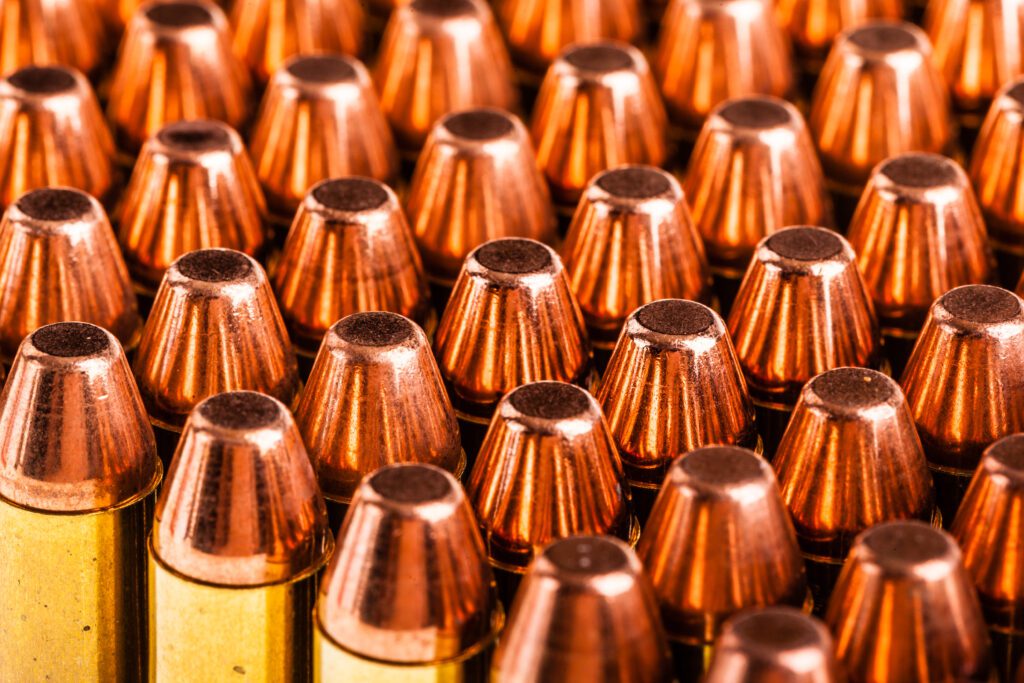
From the world’s most popular 9mm to the backcountry-crushing 10mm Auto — here’s everything you need to know about the five semi-auto pistol calibers that matter most, who they’re for, and what to buy.
Ammo Guide Series — Explore All 5 Guides:
Pistol Calibers (Semi-Auto) — You are here
Shotgun Gauges — Coming Soon
Rifle Calibers — Coming Soon
Walk into any gun store or scroll through any online ammunition retailer, and one thing becomes clear fast: the world of semi-auto pistol calibers can feel overwhelming.
Between nine-millimeter, forty-caliber, ten-millimeter, and everything in between, choosing the right cartridge matters more than most shooters realize. The ammunition you feed your handgun determines how it recoils, how many rounds you can carry, what it costs to train, and — most importantly — how it performs when you need it to.
Whether you’re a first-time buyer trying to make sense of the numbers on a box, a seasoned shooter exploring a new caliber, or someone shopping for a purpose-built carry or outdoor handgun, this guide breaks down the five most relevant semi-auto pistol calibers on the market today. We’ll cover what each one does best, where it falls short, and who it’s designed for — so you can make an informed decision without second-guessing yourself at the counter.
This is part of our Ammo Guide Series covering cartridge types across handguns, rifles, and shotguns. Check back for our revolver caliber, rifle cartridge, and shotgun shell guides as they go live.
9mm Luger: The Global Standard
There’s a reason the 9mm Luger (also called 9x19mm Parabellum) dominates every segment of the handgun market. Adopted by NATO forces, carried by the vast majority of U.S. law enforcement agencies, and chosen by millions of civilian shooters worldwide, the 9mm earned its place through a rare combination of manageable recoil, generous magazine capacity, affordable pricing, and genuinely effective terminal performance.
Modern 9mm defensive ammunition has come a long way from the round’s early reputation as underpowered. Bullet technology advancements — particularly in hollow point design — mean that today’s premium 9mm loads consistently expand to .60 caliber or larger while penetrating 12 to 18 inches in ballistic gel, which is the FBI’s benchmark window for effective self-defense ammunition. This is precisely why the FBI themselves transitioned back to 9mm in 2015 after years with the .40 S&W.
Who It’s For
Almost everyone. The 9mm is the default recommendation for new shooters, concealed carry permit holders, home defense, competition shooters (especially USPSA Production and IDPA), and anyone who wants maximum training time for minimum cost. If you’re only going to own one handgun caliber, this is the one.
Common Bullet Weights
What to Buy
For target practice and range training, Sellier & Bellot 9mm 115gr FMJ and Aguila 9mm 115gr FMJ are excellent budget-friendly options that feed reliably in virtually any pistol. Winchester USA 200-round value packs are another solid choice for high-volume range days.
For self-defense, Federal HST and Speer Gold Dot are the gold standards trusted by law enforcement nationwide. At Zeth Ammo, we carry Federal Premium HST 9mm 147gr as well as the excellent Federal Practice & Defend 100-round combo pack, which pairs 50 HST defense rounds with 50 Syntech training rounds that match the same point of impact — a smart way to train with what you carry.
.45 ACP: The Big-Bore Legend
The .45 ACP (Automatic Colt Pistol) has been stopping fights since 1911 — literally. Designed by John Moses Browning for the iconic pistol that bears that year as its name, the .45 ACP throws a heavy, slow-moving projectile that creates large wound channels and carries substantial energy on target. Its standard 230-grain bullet at roughly 830 feet per second stays naturally subsonic, making it an ideal pairing with suppressors without requiring specialized ammunition.
The .45 ACP’s devoted following centers largely around the 1911 platform, though modern polymer-framed pistols from Glock (G21, G30), Smith & Wesson (M&P 45), FN (FNX-45 Tactical), and others have expanded the caliber’s reach. The trade-off is real, though: fewer rounds per magazine (typically 7–13 depending on the platform) and noticeably more recoil than 9mm, which means slower follow-up shots for most shooters.
Who It’s For
1911 enthusiasts and traditionalists who value the .45’s proven track record. Suppressor owners who want subsonic performance without specialty ammo. Shooters who prefer a heavier, slower bullet profile and don’t mind the reduced capacity. Home defense users who want maximum impact per round.
Common Bullet Weights
What to Buy
For self-defense, Speer Gold Dot G2 .45 ACP 230gr is an outstanding choice — its elastomer-filled nose design delivers incredibly uniform expansion through barriers. Remington Golden Saber .45 ACP 230gr Bonded is another proven performer. For suppressor use, Hornady Subsonic .45 ACP 230gr XTP and Remington Subsonic .45 ACP 230gr are both excellent and in stock at Zeth Ammo.
.40 S&W: The Law Enforcement Bridge
The .40 S&W was born out of the aftermath of the infamous 1986 FBI Miami shootout, which exposed critical shortcomings in the Bureau’s 9mm duty ammunition. The resulting search for more stopping power led first to the 10mm Auto — and then to a shortened, reduced-pressure version that could fit in standard 9mm-sized frames. Smith & Wesson and Winchester introduced the .40 S&W in 1990, and law enforcement agencies across the country adopted it almost overnight.
While the .40 S&W has been losing ground to 9mm in recent years — the FBI’s own switch back to 9mm in 2015 was a watershed moment — it remains a capable cartridge that bridges the gap between the 9mm’s capacity advantages and the .45 ACP’s raw energy. Millions of .40-caliber handguns are still in service across law enforcement and civilian hands, and ammunition remains widely available and competitively priced.
Who It’s For
Current .40 S&W handgun owners who want to get the most from their existing platform. Law enforcement officers and agencies still issuing .40-caliber duty weapons. Shooters who want more energy than 9mm without stepping up to the size and capacity limitations of the .45 ACP.
Common Bullet Weights
What to Buy
For range time, Blazer Brass .40 S&W 180gr FMJ and Blazer Brass .40 S&W 165gr FMJ deliver consistent performance at a price that makes high-volume practice affordable. For defense, Federal Punch .40 S&W 165gr JHP provides excellent expansion and penetration, while Speer Gold Dot .40 S&W 165gr remains the benchmark law enforcement load in this caliber.
.380 ACP: The Pocket-Carry Favorite
The .380 ACP (also known as .380 Auto or 9mm Short) is the caliber that made truly pocket-sized pistols practical. Dimensionally similar to the 9mm but shorter and loaded to lower pressures, the .380 produces significantly less recoil — making it the top choice for ultra-compact concealed carry pistols, shooters with smaller hands, those with reduced grip strength, and anyone sensitive to recoil.
The explosion of micro-compact .380 pistols over the past two decades — models like the Ruger LCP series, Smith & Wesson Bodyguard, Sig Sauer P238, and Glock 42 — proved there was enormous market demand for a handgun small enough to carry in a pocket or ankle holster. The .380 fills that role better than any other centerfire cartridge. Modern hollow point designs have also narrowed the performance gap with 9mm, though the .380 still hits with less energy and doesn’t expand as reliably through heavy clothing barriers.
Who It’s For
Deep concealment and pocket-carry enthusiasts. Shooters who are recoil-sensitive due to age, injury, or personal preference. Backup gun carriers. Anyone who wants a capable centerfire round in the smallest possible package. The .380 is also an excellent training caliber for shooters building fundamental skills before graduating to 9mm.
Common Bullet Weights
What to Buy
For self-defense from a pocket pistol, Federal Premium HST Micro .380 ACP 99gr is purpose-built for short barrels and delivers consistent expansion where other hollow points can fail. Federal Hydra-Shok Deep .380 ACP 99gr is another premium option engineered for deeper penetration through barriers. For an affordable practice and self-defense option, Cor-Bon .380 ACP 90gr JHP offers proven expansion at a competitive price point.
10mm Auto: Maximum Semi-Auto Power
The 10mm Auto is experiencing a genuine renaissance. Originally developed in the early 1980s by Jeff Cooper and brought to market by Norma, the 10mm was briefly adopted by the FBI before being replaced by the .40 S&W (which was essentially a downloaded 10mm in a shorter case). For decades, the 10mm lived in relative obscurity — championed by a small but passionate group of enthusiasts who appreciated its unmatched semi-auto power.
What changed? The outdoor and backcountry defense market exploded. Hunters, hikers, and anglers in bear country realized that the 10mm offers genuinely useful stopping power against large, dangerous animals in a semi-automatic platform that’s faster and easier to deploy than a revolver. Glock’s G20 and G29, the Dan Wesson Bruin, Springfield’s XD-M, and Sig Sauer’s P220 in 10mm have given the cartridge accessible, modern platforms that have fueled its comeback.
Who It’s For
Backcountry adventurers who want serious animal defense in a semi-auto package. Handgun hunters pursuing medium game like deer and feral hogs. Shooters who want the most powerful mainstream semi-automatic cartridge available. Competition shooters in power-factor-heavy divisions.
Common Bullet Weights
What to Buy
For backcountry and bear defense, Hornady Backcountry Defense 10mm 200gr DGH is purpose-built for stopping dangerous game with deep, straight-line penetration and no deflection. DoubleTap 10mm 230gr Hardcast Solid is the deepest-penetrating 10mm loading available — a favorite among backcountry guides.
For self-defense, Hornady Critical Duty 10mm 175gr FlexLock delivers barrier-blind performance, while Sellier & Bellot 10mm 180gr JHP offers proven hollow point performance at an exceptional price per round. For range training, Winchester USA 10mm 180gr FMJ and PMC Bronze 10mm 200gr FMJ keep the cost manageable for a caliber that’s typically expensive to shoot.
Quick Comparison: Semi-Auto Pistol Calibers at a Glance
| Caliber | Typical Bullet | Recoil | Capacity | Best Use | Cost/Round | Shop Zeth Ammo |
|---|---|---|---|---|---|---|
| 9mm Luger | 115–147 gr | Low | 15–20+ | All-around | $0.25–$0.50 | Link |
| .45 ACP | 185–230 gr | Moderate–High | 7–13 | Defense / Suppress | $0.40–$0.70 | Link |
| .40 S&W | 165–180 gr | Moderate | 12–16 | LE / Defense | $0.32–$0.55 | Link |
| .380 ACP | 90–99 gr | Very Low | 6–12 | Pocket Carry | $0.30–$0.55 | Link |
| 10mm Auto | 165–200 gr | High | 10–16 | Outdoor / Hunting | $0.45–$0.80 | Link |
How to Choose the Right Pistol Caliber
Picking a caliber comes down to matching your intended use, your physical capabilities, and your budget to the cartridge that best serves all three. Here’s a practical decision framework:
A Note on Safety: Regardless of which caliber you choose, safe firearm handling and responsible ownership are non-negotiable. Always follow the four fundamental rules of firearm safety: treat every firearm as if it’s loaded, keep your finger off the trigger until ready to fire, never point the muzzle at anything you’re not willing to destroy, and know your target and what lies beyond it.
Before purchasing ammunition, check your state and local laws regarding caliber, magazine capacity, and ammunition type restrictions. Zeth Ammo ships to most states, including California, Washington, Connecticut, Massachusetts, and Illinois, where many competitors don’t. Visit our shipping & compliance page for the latest details.
Frequently Asked Questions
What is the best pistol caliber for self-defense?
For most people, 9mm Luger is the best all-around self-defense caliber. Modern hollow point ammunition like Federal HST and Speer Gold Dot delivers expansion and penetration on par with larger calibers, while the 9mm’s lower recoil allows faster, more accurate follow-up shots. Higher capacity magazines are an additional practical advantage in a defensive scenario. Browse our 9mm ammunition selection to find the right load for your firearm.
Is .45 ACP better than 9mm for stopping power?
The .45 ACP delivers a larger-diameter wound channel and more energy per round, but modern 9mm defensive ammunition has closed much of the terminal performance gap. The FBI’s own testing concluded that shot placement and penetration depth matter more than caliber alone, which is why they returned to 9mm in 2015. The .45’s real advantages are its naturally subsonic velocity for suppressor use and its larger bullet diameter, while 9mm wins on capacity, recoil, and cost.
Why is .40 S&W losing popularity?
The .40 S&W was originally adopted to deliver more energy than 9mm, but advances in 9mm bullet technology have narrowed that performance gap considerably. Meanwhile, the .40’s snappier recoil and reduced magazine capacity compared to 9mm are tangible disadvantages. As major agencies like the FBI switched back to 9mm, many departments followed. That said, the .40 S&W remains a perfectly effective cartridge, and shooters who already own .40-caliber handguns have no reason to abandon it.
Is .380 ACP powerful enough for concealed carry?
Yes, with the right ammunition. The .380 ACP is less powerful than 9mm, but premium hollow point loads like Federal HST Micro 99gr are specifically engineered for short-barreled pocket pistols and deliver reliable expansion. The .380’s real strength is enabling firearms small enough for deep concealment — a gun you actually carry every day is more useful than a bigger gun you leave at home.
What is the 10mm Auto used for?
The 10mm Auto has become the go-to semi-automatic cartridge for outdoor defense against dangerous game (particularly bears), handgun hunting for medium-sized game like deer and hogs, and as a maximum-power sidearm for backcountry use. Its energy levels approach those of .357 Magnum revolver loads while offering the capacity and speed of a semi-automatic. Products like Hornady Backcountry Defense 10mm 200gr are designed specifically for these demanding applications.
Can I buy ammunition online and have it shipped to my state?
In most states, yes. Zeth Ammo ships ammunition to the vast majority of U.S. states, including states where many competitors won’t ship — California, Washington, Connecticut, Massachusetts, and Illinois among them. Some states require age verification or have specific purchasing requirements. Check our shipping & returns page or contact us for details about your specific state.
What is the cheapest semi-auto pistol caliber to shoot?
The 9mm Luger is the most affordable centerfire pistol caliber, with FMJ range ammunition typically running $0.25 to $0.35 per round when bought in bulk. The .380 ACP and .40 S&W fall in the middle range, while .45 ACP and 10mm Auto are the most expensive of the five due to larger case volume and heavier bullets. If budget is a primary concern, the 9mm’s combination of low per-round cost and wide availability makes it the clear winner.
Should I carry the same ammo I practice with?
You should practice with ammunition that closely matches the recoil and point of impact of your carry load, but you don’t need to train exclusively with expensive defensive rounds. Many manufacturers offer practice-defense pairings: for example, Federal’s Practice & Defend combo pack pairs HST defensive rounds with Syntech training ammo that shoots to the same point of impact. Whatever you carry, run at least a few magazines of your chosen defensive load through your gun to confirm reliable function.
Final Thoughts
Every caliber on this list has earned its place for specific, legitimate reasons. The 9mm’s versatility makes it the default. The .45 ACP’s heritage and subsonic nature give it an enduring niche. The .40 S&W still serves millions of shooters well. The .380 ACP makes deep concealment practical. And the 10mm Auto delivers power that nothing else in the semi-auto world can touch.
The best caliber is the one that matches your intended use, that you can shoot accurately, and that you’ll actually carry or train with consistently. Pick the right ammunition for the job, practice with purpose, and carry confidently.
Ready to Stock Up?
We carry all five calibers covered in this guide — and we ship to states others won’t. For more in our Ammo Guide Series, check out our upcoming guides to revolver calibers, rifle cartridges, and shotgun shells.